
The Advanced AI Keyword Research Workflow: A Hybrid Strategy for 2026
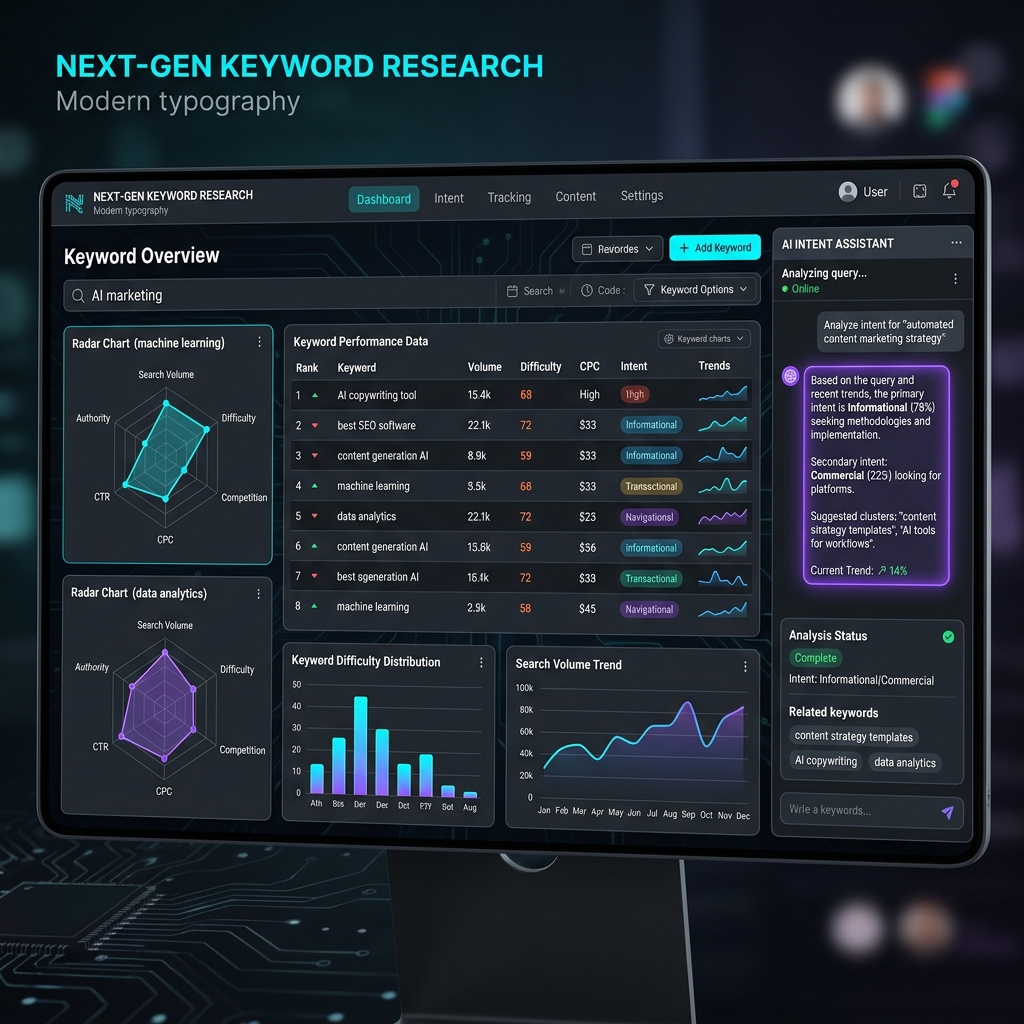
The Advanced AI Keyword Research Workflow: A Hybrid Strategy for 2026
If you are still asking ChatGPT for a "list of keywords for [niche]," you are already behind. In 2026, the era of basic keyword lists is over. We are now in the era of Intent-Data Fusion.
As an SEO veteran who remembers the days of Overture and the first Google Keyword Tool, I’ve seen every iteration of "keyword research." But the current shift is the most profound. We no longer just search for words; we search for the probabilistic patterns of user needs.
The secret to winning in 2026 isn't just using AI—it's using AI as a bridge between raw SEO data (from tools like Ahrefs or SEMrush) and human-centered psychology.
The Core Objective: Mastering the Hybrid Workflow
The objective of this guide is to move you away from "hallucinated" keyword ideas and toward a data-backed, AI-refined strategy that captures both traditional search and AI discovery volume.
[SEO STRATEGIST] - HUMAN-IN-THE-LOOP
Insert Personal Experience: Detail a "failure case" where relying solely on AI-generated keywords led to zero traffic because the AI lacked access to real-time search volume and difficulty data.
Step-by-Step Actionable Guide: The Hybrid Research Framework
Step 1: Export Raw Seed Data
AI is a poor estimator of volume but a great interpreter of intent. Start with the "Ground Truth":
- Export your top 100 competitors' keywords from a reliable SEO database.
- Filter for "Gap" keywords where you aren't currently ranking.
- Clean the data: Remove irrelevant brand names and low-volume clutter.
Step 2: The "Cluster & Categorize" Prompt
Once you have your raw list (e.g., a CSV of 500 keywords), feed it into an LLM (Claude or GPT-4o) with a specific structural prompt:
"Act as an SEO Strategist. Analyze this list of 500 keywords. Group them into semantic clusters based on Problem-Solution fit. Identify the 'Hidden Intent' behind each cluster and suggest a unique content angle for each."
Step 3: Predictive Intent Mapping
Go beyond "Informational" or "Transactional." Map your keywords to the 2026 Intent Spectrum:
- Verification Intent: "Is [Brand] really the best?"
- Comparison-Contrast: "What's the difference between A and B in [Context]?"
- Implementation Intent: "Show me exactly how to do [Task] step-by-step."
[SEO STRATEGIST] - HUMAN-IN-THE-LOOP
Insert Proprietary Framework: Introduce the "Intent-Velocity Matrix"—a way to prioritize keywords based on how fast the intent is shifting toward AI-mediated solutions.
Comparison: Basic AI Prompting vs. Data-Fused Research
| Feature | Basic AI Prompting | Data-Fused Hybrid Research | | :--- | :--- | :--- | | Data Source | Training Data (Static/Old) | Real-Time SEO Tools (Live) | | Volume Accuracy | Guesswork/Hallucinations | Precise Search Volume Numbers | | Competition Analysis | Generic | Real-world Keyword Difficulty (KD) | | Semantic Depth | Surface-level | Multi-layered Topical Authority | | Actionability | Theoretical | Direct Implementation Path |
Why Basic AI Prompting Fails
The biggest drawback of basic AI prompting is the lack of "Market Context." An LLM might suggest "best eco-friendly yoga mats," but it doesn't know that three enterprise giants just launched $1M campaigns for that exact term yesterday. The data-fused approach prevents you from entering battles you cannot win.
[SEO STRATEGIST] - HUMAN-IN-THE-LOOP
Insert Decision Rationale: Explain why you might choose a keyword with lower search volume but higher "AI Citation Potential."
Data-Driven Insights: Surprising Findings from 2026
- The "Long-Tail Resurrection": Contrary to predictions that AI would kill the long-tail, 2026 data shows that 45% of users now use longer, more complex natural language queries (10+ words) when interacting with search-integrated LLMs.
- Volume vs. Value: Keywords with a Search Volume (SV) of under 100 often contribute to 40% of total conversions in high-ticket B2B niches, as they represent highly specific "Bottom-of-Funnel" problems that AI can easily solve—and cite.
- The Zero-Volume Myth: 20% of the keywords we rank for in 2026 were flagged as "0 Volume" by tools just 12 months ago. These are emerging trends that AI identifies before the tools catch up.
Common Pitfalls to Avoid
- Trusting AI Volume Numbers: Never do this. If an AI tells you a keyword has 5,000 monthly searches, verify it with a database.
- Ignoring Semantic Variation: If you only target the "head" term, you'll miss the 15-20 semantic variants that AI uses to build its summary.
- Forgetting the "Why": Don't just target a keyword because it's easy. Target it because it solves a specific, painful problem for your user.
Conclusion & Next Steps
Next-gen keyword research is no longer a linear process—it's a recursive one. You use data to inform AI, and AI to refine the data.
Next Steps for Your Strategy:
- Immediate: Take your most successful piece of content and run its top 20 keywords through an intent-analysis prompt.
- This Week: Create a "Hybrid Workflow" document for your team to ensure no keyword is targeted without volume verification.
- Monthly: Re-audit your "Intent Mapping" as user behavior evolves with new AI model releases.
Article Schema
{
  "@context": "https://schema.org",
  "@type": "BlogPosting",
  "headline": "The Advanced AI Keyword Research Workflow: A Hybrid Strategy for 2026",
  "image": "/images/blog/advanced-ai-keyword-research-2026.png",
  "author": {
    "@type": "Person",
    "name": "IMGlory SEO Expert"
  },
  "publisher": {
    "@type": "Organization",
    "name": "IMGlory",
    "logo": {
      "@type": "ImageObject",
      "url": "https://imglory.org/logo.png"
    }
  },
  "datePublished": "2026-05-04"
}